

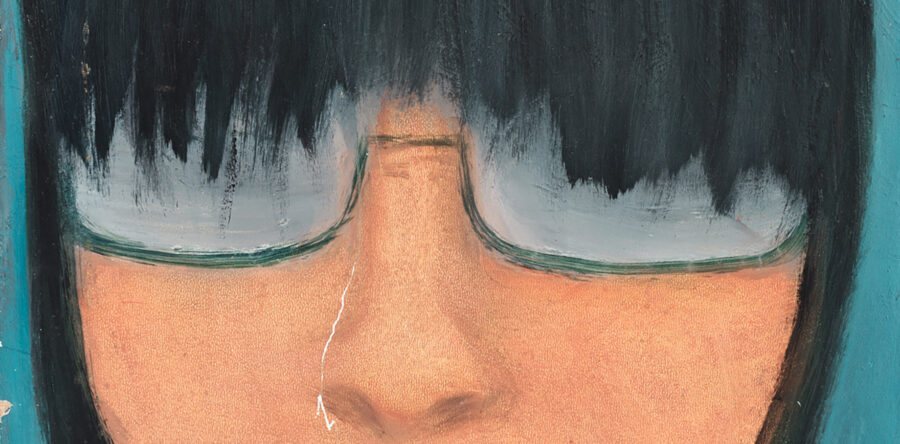
This Is What I See From The Back Window At Sunset
Toto vidím cez zadné okno pri západe slnka
Ezt látom a hatsó ablakból naplementénél
Akava si so dikhav kotar o paluno phani kana o kham perel
Curators: Péter Bencze, Zuzana Janečková
Exhibition opening: 27. 1. 2026 at 6pm.
Exhibition period: 28. 1. - 16. 5. 2026
Space Q, Hlavná 27, Košice
The exhibition This Is What I See From the Back Window at Sunset presents a selection of works by OMARA Mara Oláh (1945–2020), an artist best known for her expressive paintings featuring striking textual elements and a wide range of media. OMARA began creating art at the age of 43 following the death of her mother and the onset of her own health problems. Although she lacked formal training, she produced authentic and highly original works that stand as powerful testimonies to life, identity, and social relationships from the perspective of a Roma woman living in the second half of the twentieth century.
Today, she is considered one of the most significant and widely exhibited Roma women artists on the international art scene, with her works included in the collections of numerous renowned institutions.
The dramaturgy of the exhibition introduces viewers to multiple layers of OMARA’s life and practice. Paintings and a 2024 short film by the Hungarian director Ábel Santa present fragments of her biography, including her television appearances as a fortune teller. This aspect inspired the architectural concept of the exhibition and resonates with the curatorial interpretation, which operates on a metatextual level, deliberately moving away from strictly art historical readings of individual works and instead offering an experimental spectrum of meanings.
A crucial chapter in OMARA’s life began when she moved to the village of Szarvasgede, where she built what she called her “luxury shack”: her own wooden house with a swimming pool adapted entirely to her wishes. As a member of an ethnic minority, she encountered prejudice and hostility, yet she overcame these challenges through her extraordinary energy and sense of humour. She knew exactly what she wanted and what she did not, and her spontaneity proved magnetically appealing. She often inhabited the exhibition spaces themselves, occasionally guiding visitors through her shows at four o’clock in the morning. Her work provides deep insights into her culture, philosophy and unforgettable style, while also revealing her activism, including visits to prisons.
Another turning point came in 1988 when she painted her first artwork, a portrait of Sophia Loren based on magazine cut outs collected by her daughter; OMARA made the painting as she waited for her child to come back with money to pay the doctor for the treatment of her severe headaches.
OMARA had lost her sight in one eye in 1983, and this experience later shaped her self-identification as the “one eyed Gypsy OMARA”, the artist who would go on to conquer the world with her vision of a free life. From 1988 onward, her artistic career quickly gathered momentum; in 1993 the Mara Gallery, the first Romani gallery in Hungary, was founded, and by 2004 she was attracting international recognition. Her work has been exhibited at documenta fifteen in Kassel, the Berlin Biennale 2025, the Ludwig Museum in Budapest, the Romani Pavilion at the Venice Biennale, and the Kunsthalle Wien.
The central section of the exhibition focuses on OMARA’s paintings, offering an overview from her earliest experiments to her final works. Her first drawings and paintings emerged as responses to physical pain, later expanding into self portraits, depictions of her daughter, motifs linked to the house she built, and reflections on women’s rights, Roma emancipation and universal human rights.
Special attention is given to her so called “Blue Period” from 1997 to 2015, a series of works characterized by the incorporation of written commentaries into her compositions. Alongside these are her striking “red” paintings. Miniatures form another important chapter, consisting of works produced between 2010 and 2020 on unconventional media such as cigarette packets and wooden wedges. While many of her paintings record the milestones of motherhood and social struggle, other series, such as Dancing Trees, explore landscapes, flowers and arboreal motifs. The exhibition’s title is drawn from a phrase inscribed on one of these works, resonating metaphorically with both her eye operation and her fortune telling practice.
The exhibition features special tarot cards which OMARA designed based on her own paintings. Later printed as inserts in women’s magazines, the cards depict motifs drawn from everyday life and are accompanied by explanatory texts explaining their symbolism. Also included are original recordings of OMARA’s television appearances, during which she told the fortunes of viewers who called into her show.
Visitors enter a visually immersive world saturated with colour and deeply affecting reflections on life, accompanied by music OMARA loved, such as songs by Karel Gott and Engelbert Humperdinck.
An educational guidebook in the form of the artist’s own zine accompanies the exhibition, alongside a limited edition series of matches.
Featuring loaned works from and in collaboration with: Romano Kher Roma Cultural Center in Budapest, Everybody Needs Art and Longtermhandstand Budapest, BS Collection, Cone Collection, Olivér Hont Collection, Athens; Terka Horváth Collection, Amsterdam; Réka Lőrincz, Ábel Sánta.
The exhibition was supported using public funding by Slovak Arts Council.

