
Opening: 28 October 2026, 6:00 pm
Curator: Lucia Gavulová
Exhibition period: 29 October 2026 – 28 February 2027
Space C, Hlavná 27, Košice
In the spring of this year, visual artist Pavla Sceranková approached me asking whether I would undertake curating an exhibition of her father – the artist Peter Sceranka (1955–1999) – at the East Slovak Gallery in Košice. Peter Sceranka was a trained sculptor whose work developed in parallel through the mediums of painting, drawing, collage, and sculpture. He was intensely active artistically during the 1980s and 1990s. I accepted this offer with humility and joy. Not only due to the exceptional qualities of his work, but also because of the affinity I feel for the family cohesion of his wife and four children – Pavla, Lucia, Zuzana, and Matúš Sceranka, all of whom are dedicated to artistic and creative activities.
For Peter Sceranka's exhibition at the East Slovak Gallery (hereinafter referred to as the VSG), where his solo exhibition already took place in 2008 (Peter Sceranka, curated by Vladimír Beskid), its architectural concept is defining. After all, architecture is a strongly present element in the Sceranka family. In addition to their son Matúš, Pavla and especially Peter's wife, Zuzana Sceranková, are also dedicated to it. For the exhibition at the VSG, which takes place in a narrow, longitudinally oriented space without daylight, the core element is a wooden structure of a head, divided into a series of frames floating along the central axis of the room. "I often think about how to grasp the exhibition. I imagined an image where a head in sections made of wooden frames is stretched along the room, while drawings and small sculptures are also placed within the individual sections/frames," Pavla wrote in a message dated May 15, 2026. Ultimately, she brought this vision to life.
The family had already worked with the motif of the head as an architectural element during the exhibition In the Head of Peter Sceranka (2022–2023) at Prague's community space Olga, where it took the form of a compact suspended structure. In the case of the Košice exhibition, the head is expanded into a series of spatial sections running through the center of the elongated room. The construction is open and accessible to walk through. This openness can also be perceived as a reference to the fact that Peter Sceranka's work is not entirely closed. Not only because his life ended prematurely, but also because his work continues in a certain way through the artistic endeavors of his children and family. The individual frames can simultaneously be understood as symbolic echoes or signals that remain present, spread through space, and acquire new meanings.
Moreover, the head is one of the recurring motifs in Sceranka's work itself. As a person and an artist, he was intensely immersed in his own inner world. We could also consider his studio, where according to the memories of his loved ones he spent a great deal of time in focused work, as a certain metaphor for the head. Pavla Sceranková's wish was to achieve an experience of intensity through the walk-through wooden structure and the concentration of individual pieces – a culmination of thoughts, impulses, and impressions swirling in swarms and relentlessly occupying the mind. To such an extent that the viewer at times loses the ability to distinguish where one image ends and another begins.
The impression of swarming, culmination, and openness is also supported by the formal aspect of the individual works on paper. The line layers, thickens, breaks, and scatters. Structures emerge that blur the boundaries between the inner and outer, the full and empty, the material and immaterial. Drawing approaches vary widely. If Sceranka draws figures, they are usually in hints that appear and vanish. Anatomical associations shift into abstract configurations; organic shapes intertwine with geometric and spatial constructions. The pictorial space does not follow a stable perspective order but emerges as a fluid field of relationships in which individual interventions attract, overlap, or distance themselves from one another.
Color interventions, flat accents, and collage fragments enter the drawing without creating a clearly hierarchical composition. Color is not merely a supplement to the line or a means of modeling volume; it becomes an independent agent that changes the rhythm of the drawing, disrupts its continuity, and creates new spatial relationships. In some works, the drawing gesture approaches a painterly one, while elsewhere the color plane acts as a fragment, an intervention, or a trace. Drawing and painting meet in an open process in which it is not always possible to determine where one medium ends and another begins. The apparent instability of the drawing does not lie in denying its material nature, but in its ability to evoke an impression of constant transformation – the form here does not appear definitively closed. A similar principle of openness and mutual permeation applies to the architectural design of the exhibition, where individual works enter into new relationships through the open structure of the wooden frames.
From a curatorial perspective, working on the final form of the exhibition was a process that took place in close cooperation with the author's children. We decided to present predominantly works on paper. The reason was partly the specific layout and dimensional limits of the exhibition space, and partly the intention to present the widest possible spectrum of Sceranka's creative approaches. Works on paper – drawings, collages, and paintings – allow this diversity to be conveyed in an extraordinary concentration. In the exhibition, they are complemented by two of the artist's sculptures – a reclining wooden head before the entry to the gallery space and a small sculpture of a shot putter opposite the entrance to the exhibition tour.
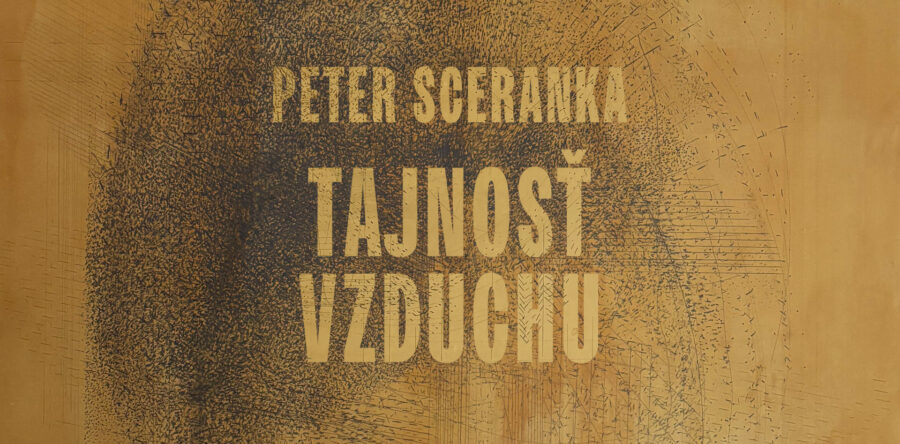
The Secrecy of Air is the title of the artist's eponymous 1994 drawing, which concentrates several characteristic features of his work from this period. It was precisely in the 1990s that drawing acquired an increasingly prominent position in Sceranka's work, gradually becoming an autonomous space for artistic reasoning. Through focused and systematic work, the artist developed a distinctive visual language within it. The title The Secrecy of Air also opens up a broader interpretive field. It evokes something present yet difficult to grasp, something that cannot be fully bounded or contained. In this sense, it corresponds with the nature of Sceranka's drawings, as well as with the architectural layout of the exhibition, which offers an open and permeable form instead of a closed one.
Peter Sceranka had a strong relationship with his family, not only with the closest one but also with his roots. It was these roots that, after his studies in Bratislava, brought him back to Košice, near Klátov, where he was born. Thus, in the context of the exhibition, the motif of the head acquires multiple layers of meaning. It is a vessel for thought, memory, and imagination, but also a symbol of personal identity and continuity. In Sceranka's work, it repeatedly appears as a visual motif, while in the architecture of the exhibition, it becomes a space that can be entered. It is as if the author's inner world opened up for a moment to an outside view. Not, however, as a definitively closed whole, but as a living structure of relationships, images, and thoughts that remain present through his works and the life or work of his children and closest family.
– Lucia Gavulová
Peter Sceranka (1955, Košice – 1999, Košice) was a Slovak sculptor, draughtsman, and painter. From 1976 to 1981, he studied at the Academy of Fine Arts in Bratislava in the studio of figurative sculpture. Although his artistic education was rooted in sculpture, drawing became an increasingly significant and ultimately defining part of his practice. He explored figurative motifs, the head, and the human body, gradually transforming them into loose gestural, spatial, and abstract structures. His large-format drawings from the 1990s are particularly characteristic, exploring the possibilities of line, volume, movement, and inner space. In 1992, he was awarded first prize for drawing at the International Biennial of Art in Barcelona. He lived and worked in Košice, where he died prematurely. His work represents a distinctive and still insufficiently acknowledged strand of Slovak art of the final decades of the 20th century.

