
Opening: 9. 10. 2025, 18.00
Curator: Miroslav Kleban
Exhibition period: 10. 10. 2025 – 11. 1. 2026
Space Q, Hlavná 27, Košice
The work of the Slovak contemporary artist Michal Nagypál oscillates along the razor-thin borderline between reality and fiction, between the close observation of the world and imaginative transformations which grant it new meaning. His characteristic approach can perhaps be best summed up by the phrase “a provisional agreement between reality and illusion” – the fundamental concept which underpins both his painting and his digital experimentation. Nagypál refuses to accept reality as an indisputable fact, seeing it instead as a material which can be deformed, mirrored, expanded or poetically rewritten. The resulting work emerges as a synthesis of magic realism, surrealistic strategies and contemporary reflections on the post-digital image.
Nagypál is faithful to the traditional medium of painting: oils on canvas, which he combines with an intricate modelling of forms. His works are remarkable for their material understanding of the painterly craft accompanied by an emphasis on detail, as is apparent in the subtly graduated tones in his depictions of the sky, the textures of animal fur or the structure of the surfaces of plants. In a technical sense, or in the preparation of a preliminary painting, Nagypál uses digital tools which allow him to create mirrored compositions of images, deforming the paintings and transforming them into visual paradoxes. In another sense, however, his unmanipulated photographic depictions are a tool for the creation of other cycles of paintings which evoke a distinctly hyperrealist impression. Indeed, it is possible to argue that the combination of analogue and digital techniques forms the core of his creative approach – the painting is not an isolated medium but is instead part of a wider visual laboratory, with sculptures and small-scale graphics among its other products. The “Photoshop” approach, the manipulation of the image through distorting, mirroring, expanding and cropping, acquires a new aspect in Nagypál’s case, emerging as a form of sketching, the emergence of a template for the resulting composition.
Nagypál’s iconography is predominantly concerned with the theme of nature and the inherent fragility of its beauty. Trees, animals, clouds and bodies of water are depicted in scenes which seem familiar, but which also appear to have been transposed to the realm of dreams. Nature here is by no means idyllic; its latent threats are ever present – storms, floods, landslides and other apocalyptic scenarios. The Calamities series explores the topic of natural catastrophes, events which form an integral part of our ecological consciousness. The motifs of death and decay intersect with mystical elements – flora and fauna acquire a symbolic value, oftentimes in an animistic sense. The trees seem to have eyes, and animals serve as messengers from another realm. We can discern references to the inheritance of surrealism, the point at which the barriers between the living and the non-living, the real and the fantastical, start to break down.
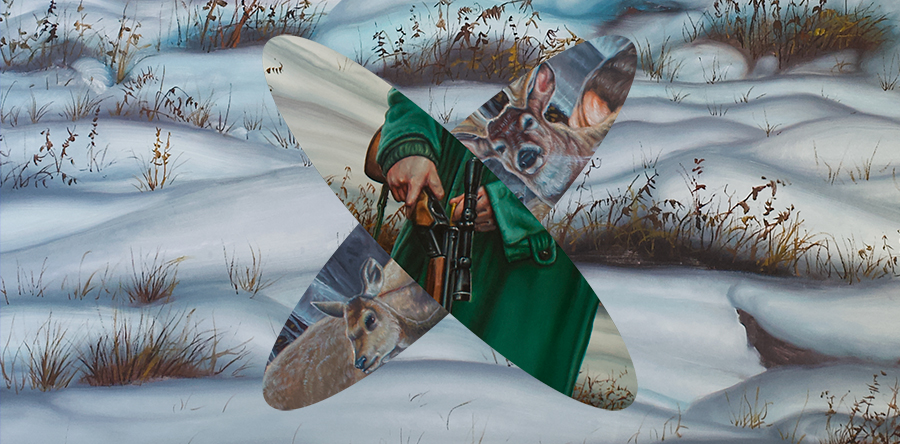
Nagypál reflects a wider international context in which the themes of ecology, climate catastrophe and posthumanistic perceptions of nature are gaining increasing significance. One example of this is the series of ten large-format paintings titled The Hunt, created between 2024 and 2025, which illustrates the artist’s interest in taking an alternative (yet still empirical) perspective to environmental themes, in this case by exploring the phenomenon of hunting. Regardless of what our personal thoughts on the activity may be, the hunt does represent an intersection point between the themes of protecting life and the inevitability of physical extinction. Nagypál styles himself in the role of hunter while simultaneously positioning himself as a cultural anthropologist. Through sketches featuring realistic depictions of archaic hunters, the artist offers several narratives which draw us back into the mind of the prehistoric hunter. The main theme, however, is the theory of hunting the soul of the animal, a line of thought which opens up new layers of meaning – biological, spiritual, ethnic and religious. The artist also draws inspiration from, among others, the work of the Flemish painter Frans Snyders (1579 – 1657) or the Finnish artist of the late nineteenth and early twentieth century, Akseli Gallen-Kallela (1865 – 1931).
Ecological issues and the world of flora and fauna hold a special mystical significance for Nagypál – his works are visually legible, yet the viewer must navigate between reality and illusion in interpreting their meaning. The paintings are symbols of transformation, mirrors held up to human existence. Flora and fauna acquire a sacred dimension which are associated with archetypal images. Natural catastrophes are presented here as metaphors of human fate, its fragility and the inevitability of its demise. Mysticism is intertwined with science – as if the painter is seeking out a new visual language by which to interpret the planet and society in the era of the Anthropocene.
A fundamental aspect of Nagypál’s work is his efforts to reinterpret well known paintings from art history. In the series titled Crossroads, Nagypál applied his painterly expression to the copyist’s craft, but this is not his main intention, nor is it the formal result. His digital deformation of Renaissance paintings testifies to his deliberate exploration of visual memory. The masterpieces of the Northern Renaissance, the paintings which emerged in the Low Countries in the 15th and 16th centuries, become material for Nagypál’s own work. By mirroring and symmetrizing these famous images he forms new compositions reminiscent of Rorschach tests, psychological games which each viewer can perceive differently, projecting their own subconscious into the works. A remarkable form of “abstract” realism emerges; an oxymoron, of course, yet one which casts us into an reality which appears intoxicated, in every sense of the word.
Michal Nagypál (1992) studied Advertising Art at the School of Applied Art in Košice from 2008 to 2012. He continued his studies at the studio of Martin Meiner at the Academy of Fine Arts in Prague (2012 – 2016) and from 2017 to 2018 he undertook an internship at the sculpture studio of Lukáš Rittstein. He currently lives and works in the Hungarian town of Gönc.
The realisation of the works was supported using public funding in the form of a scholarship by the Slovak Arts Council.


